
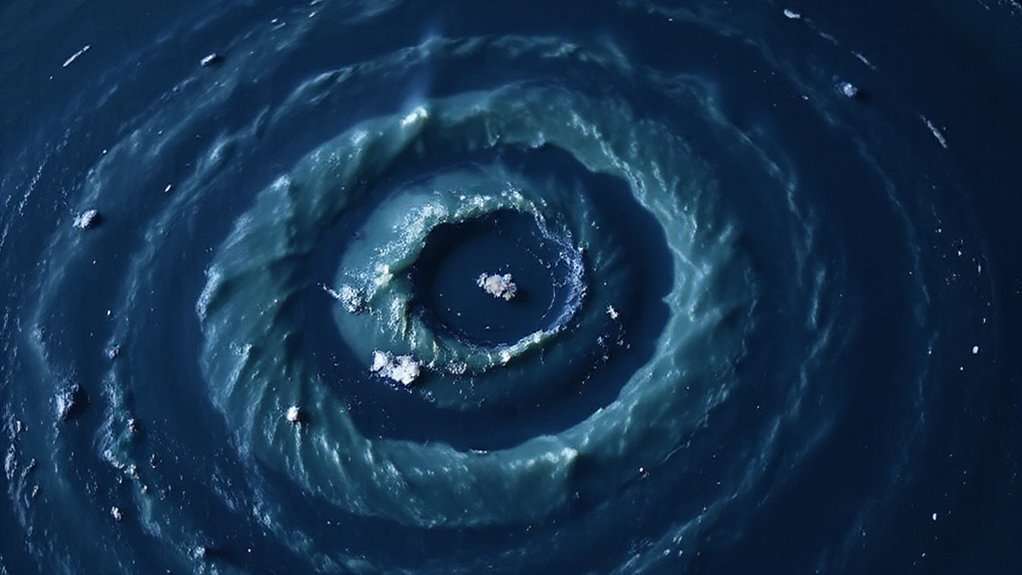
Britain’s coastal waters harbour an unexpected secret: massive underwater cyclones called mesoscale eddies. These hidden whirlpools, typically spanning less than 100 kilometres, churn beneath the surface like nature’s washing machines. They’re constantly forming, mixing nutrients and warmth whilst influencing local ocean dynamics. Most holidaymakers splash about, blissfully unaware of these powerful forces churning below. These mysterious underwater storms reveal a complex turbulent world that shapes Britain’s marine ecosystem in ways we’re only beginning to fathom.
Hidden Underwater Eddies Reshape Britain’s Marine Landscape
While most Britons focus on the weather above their heads, a hidden meteorological drama unfolds beneath the waves surrounding their island nation. These mysterious oceanic features, known as mesoscale eddies, are creating quite a stir among marine scientists. They’re like underwater cyclones, really – but don’t expect the BBC weather team to mention them in tonight’s forecast.
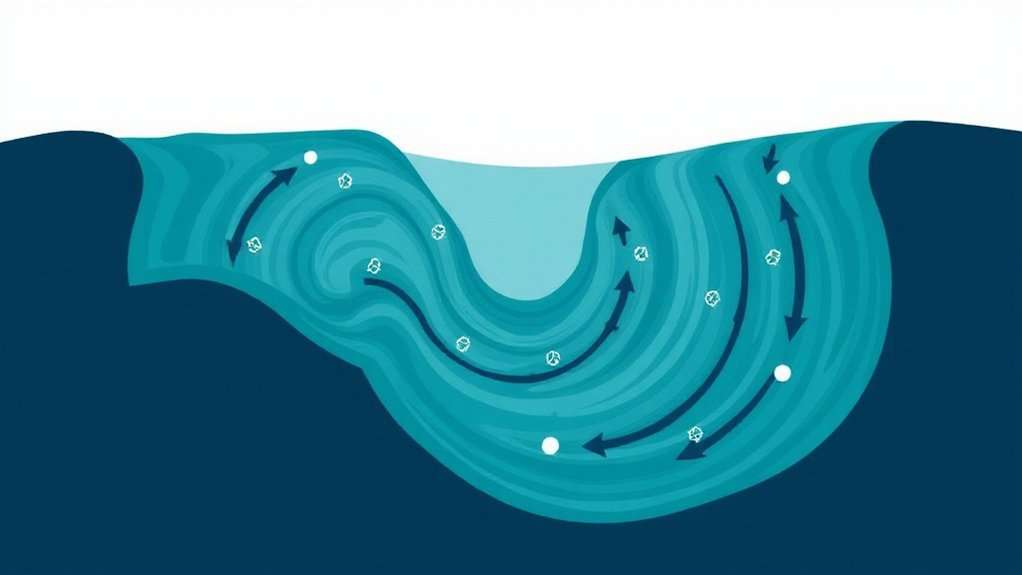
These fascinating whirls of water typically stretch less than 100 kilometres across, churning away beneath the surface for roughly a month at a time. Rather impressive, when you think about it. They’re proper three-dimensional beasts, diving deep into the ocean’s pycnocline, affecting everything from temperature to salinity. Talk about ocean turbulence – these aren’t your average ripples in the paddling pool. Much like the Special Operations Executive, these eddies operate in secrecy, conducting their vital work hidden from public view.
Britain’s waters are particularly interesting, given their proximity to notable boundary currents. These currents spawn eddies like an overenthusiastic baker churning out scones. The process is dead simple, actually – well, if you consider baroclinic instability and complex density gradients simple. Similar to how the Anglo-Saxons required every 300 hides to provide a warship, these currents consistently generate new eddies to maintain ocean circulation.
Scientists tracking these underwater storms use everything from satellite imagery to underwater gliders, though sometimes these sneaky eddies play hide and seek beneath the thermal stratification.
The impact on British waters is profound, though most holiday-makers wouldn’t notice whilst paddling at Blackpool. These eddies are proper workhorses, mixing up nutrients and heat like a giant underwater washing machine. They’re particularly active near western boundary currents, which makes Britain’s maritime neighbourhood rather lively beneath the surface.
The scientific community is particularly chuffed about studying these features, as they’re essential for understanding both local ocean dynamics and broader climate patterns. It’s not just academic faff, mind you. These eddies considerably influence deep-ocean currents and marine ecosystems around Britain’s shores.
They’re basically the ocean’s version of weather – though considerably wetter than your typical British drizzle.
The detection of these hidden eddies requires quite the technological arsenal. Satellites can spot surface expressions, but it’s the sea surface height anomaly data that really gets scientists excited. Sometimes, though, these crafty eddies hide beneath thermal layers, making them about as easy to spot as a submarine in a haystack.
Britain’s waters, it turns out, are far more dynamic than the casual observer might suspect. These mesoscale eddies are constantly at work, stirring up the neighbourhood like underwater troublemakers. They might be hidden from view, but their impact on local waters is anything but subtle.
[affai keyword=”British coastal water monitoring equipment” template=”carousel” count=”3″